More than 33 million people worldwide live with atrial fibrillation alone, and that number does not include the millions more managing other forms of irregular heartbeat. Yet a large portion of those individuals go undiagnosed for years, unaware that their occasional palpitations, fatigue, or shortness of breath point to a treatable heart rhythm disorder. If you or someone you love has been told their heart rhythm is “off,” comprehending the full range of treatment options is the first step toward a safer, healthier life.
At New York Preventive Health Center (NYP Clinic), our Heart Care Services and Cardiologist in Forest Hills, NY are designed to give patients in Queens and across the NYC area fast, expert access to cardiac evaluation and personalized arrhythmia care, without the long wait times that often delay critical treatment.
Heart Care Services and Cardiologist in Forest Hills, NY.
Key Takeaways
- An irregular heartbeat (arrhythmia) ranges from harmless to life-threatening, and treatment depends entirely on the type, severity, and underlying cause.
- Medications, minimally invasive procedures, implantable devices, and lifestyle changes are all proven treatment pathways.
- Stroke prevention is a critical component of managing atrial fibrillation, often requiring anticoagulant therapy.
- Early diagnosis through monitoring tools like Holter monitors dramatically improves treatment outcomes.
- Patients in Forest Hills and Queens have access to board-certified cardiology care at NYP Clinic, open 7 days a week.
Comprehending Irregular Heartbeat: What Is an Arrhythmia?
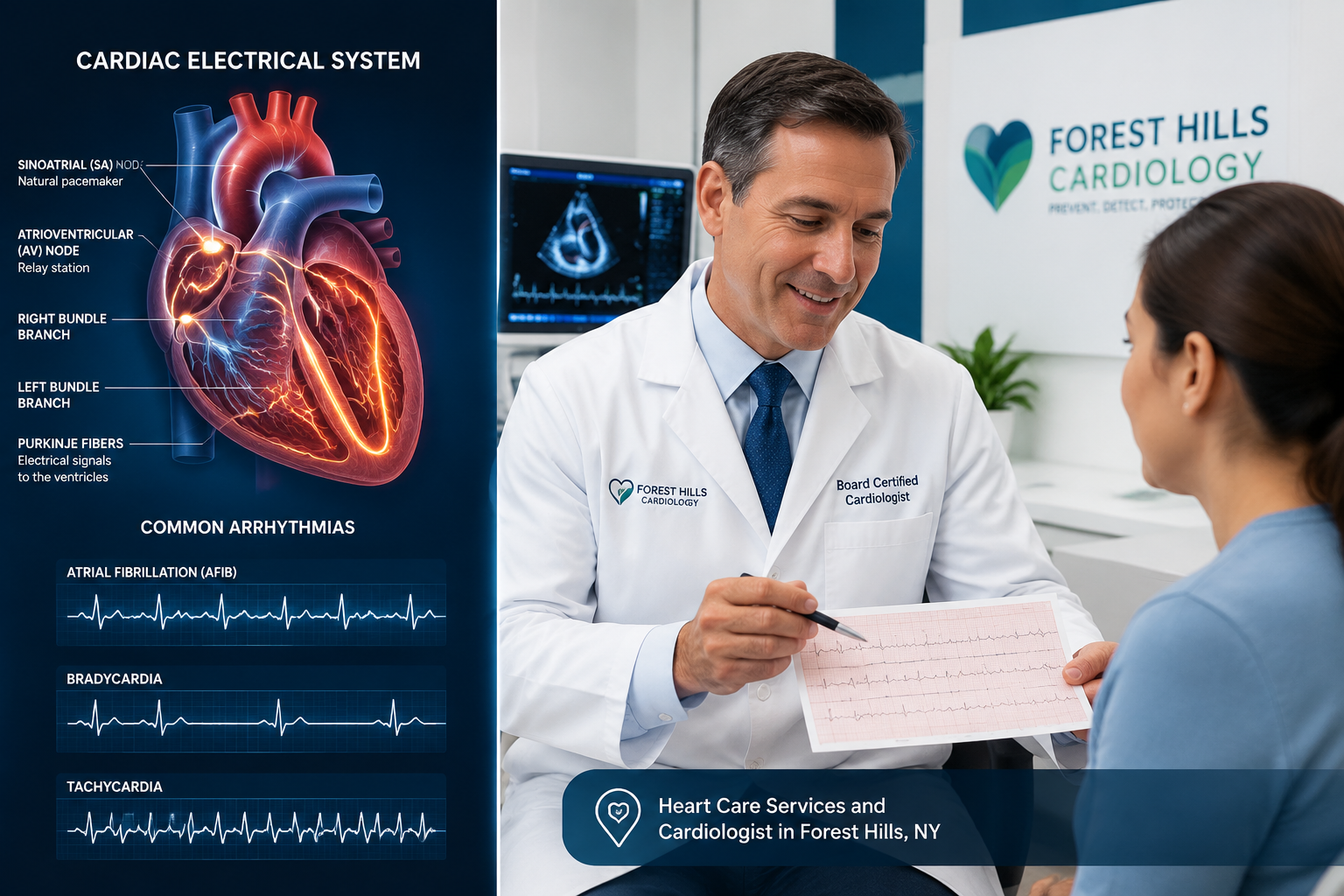
An arrhythmia is any disruption in the normal electrical rhythm of the heart. The heart relies on a precise sequence of electrical signals to pump blood efficiently. When those signals fire too fast, too slow, or erratically, the result is an irregular heartbeat.
Common types of arrhythmia include:
- Atrial fibrillation (AFib), the most common, involving chaotic electrical activity in the upper chambers
- Atrial flutter, similar to AFib but with a more organized, rapid pattern
- Tachycardia, a resting heart rate above 100 beats per minute
- Bradycardia, a resting heart rate below 60 beats per minute
- Ventricular fibrillation, a life-threatening rhythm that can cause sudden cardiac arrest
- Premature contractions, early heartbeats that feel like a “skipped” beat
Not every arrhythmia requires aggressive treatment. Some are benign. Others, particularly ventricular arrhythmias and AFib, carry serious risks including stroke, heart failure, and sudden cardiac death. That is why a thorough evaluation by a qualified cardiologist is essential before any treatment plan is established.
To comprehend whether your symptoms may signal something more serious, review our guide on four signs your heart may be quietly failing.
The Best Treatments for Irregular Heartbeat

There is no single “best” treatment for every arrhythmia. The optimal approach depends on the type of arrhythmia, the patient’s overall health, risk factors, and personal preferences. Below is a comprehensive breakdown of all major treatment categories, from the least invasive to surgical options.
Medications: Rate Control and Rhythm Control
Medications are typically the first line of treatment for most arrhythmias.
Rate control medications aim to slow the heart rate to a normal range without necessarily restoring a perfect rhythm. The most commonly prescribed include:
- Beta blockers (e.g., metoprolol, atenolol), reduce the heart’s response to adrenaline
- Calcium channel blockers (e.g., diltiazem, verapamil), slow electrical conduction through the heart’s AV node
Rhythm control medications, also called anti-arrhythmic drugs, attempt to restore and maintain a normal sinus rhythm. These are more potent and carry a higher risk of side effects, so they require careful monitoring by a cardiologist.
Anticoagulants for stroke prevention are a critical part of AFib management. Because AFib allows blood to pool in the heart’s upper chambers, clots can form and travel to the brain. Medications like warfarin and direct oral anticoagulants (DOACs), including apixaban and rivaroxaban, significantly reduce this stroke risk.
“Treating the rhythm is only part of the equation. Protecting the patient from stroke is equally important in AFib management.”
For patients managing related cardiovascular risk factors, our resource on cholesterol management from cardiology experts offers additional context on how lipid control ties into heart rhythm health.
Vagal Maneuvers
For certain types of rapid heartbeat, particularly supraventricular tachycardia (SVT), simple techniques called vagal maneuvers can slow the heart rate quickly. These include:
- Bearing down as if having a bowel movement (Valsalva maneuver)
- Coughing forcefully
- Applying a cold pack or cold water to the face
These techniques stimulate the vagus nerve, which naturally slows heart rate. They are not appropriate for all arrhythmias and should only be used under medical guidance.
Electrical Cardioversion
When medications fail to restore normal rhythm in AFib or atrial flutter, electrical cardioversion is often the next step. During this procedure, a controlled electric shock is delivered to the heart through pads placed on the chest. The goal is to “reset” the heart’s electrical system back to a normal sinus rhythm.
Cardioversion is typically performed in a hospital or clinical setting, and patients are sedated for comfort. It is generally safe and effective, though the arrhythmia may return over time without additional treatment.
Catheter Ablation
Catheter ablation is a minimally invasive procedure that has become one of the most effective long-term solutions for certain arrhythmias, particularly AFib and SVT. A thin, flexible tube (catheter) is inserted through a blood vessel and guided to the heart. The tip of the catheter delivers either heat (radiofrequency energy) or cold (cryoablation) to create small scars in the heart tissue.
These scars block the abnormal electrical pathways that cause the arrhythmia. For many patients, catheter ablation significantly reduces or eliminates arrhythmia episodes, sometimes reducing the need for long-term medication.
This procedure is typically performed by an electrophysiologist, a cardiologist who specializes in heart rhythm disorders.
Implantable Devices
When arrhythmias cannot be adequately controlled with medications or ablation, implantable devices offer continuous, automatic protection.
| Device | Used For | How It Works |
|---|---|---|
| Pacemaker | Bradycardia (slow heart rate) | Sends electrical impulses to maintain a minimum heart rate |
| ICD (Implantable Cardioverter-Defibrillator) | Ventricular tachycardia / fibrillation | Detects dangerous rhythms and delivers a shock to restore normal rhythm |
| CRT Device (Cardiac Resynchronization Therapy) | Heart failure with arrhythmia | Coordinates contractions between the heart’s chambers |
Surgical Interventions
For patients who do not respond to other treatments, surgical options exist. The Maze procedure is the most established surgical approach. During open-heart surgery or a minimally invasive version, surgeons create a pattern of scar tissue in the atria to redirect electrical signals along a controlled pathway. This is often performed alongside other heart surgeries such as valve repair.
Surgery is typically reserved for severe, treatment-resistant cases or when a patient requires heart surgery for another reason simultaneously.
To know when arrhythmia or other heart conditions may require hospitalization, read our article on when heart conditions require inpatient cardiac treatment.
Lifestyle Changes That Support Heart Rhythm Health
Medications and procedures treat the arrhythmia directly, but lifestyle modifications address the root causes and reduce the likelihood of recurrence. These changes are not optional add-ons, they are a core part of any effective arrhythmia management plan.
Main lifestyle strategies include:
- Managing high blood pressure, hypertension is one of the leading triggers of AFib
- Maintaining a healthy weight, obesity increases arrhythmia risk significantly
- Treating sleep apnea, untreated sleep apnea is strongly linked to AFib recurrence after ablation
- Limiting alcohol consumption, even moderate drinking can trigger arrhythmia episodes in susceptible individuals
- Reducing caffeine, though evidence is mixed, some patients are sensitive
- Managing stress, chronic stress elevates cortisol and adrenaline, both of which can disrupt heart rhythm
- Regular physical activity, moderate aerobic exercise strengthens the heart muscle
For dietary guidance that supports heart health, explore our resource on the best diets to protect your heart and improve longevity.
Additionally, conditions like metabolic syndrome significantly increase the risk of both heart disease and arrhythmia. Our article on how metabolic syndrome increases the risk of heart disease and diabetes explains the connection in detail.
Monitoring and Ongoing Management
Effective arrhythmia care does not end with a single treatment. Continuous monitoring is essential to assess whether a treatment is working and to catch new episodes early.
Common monitoring tools include:
- Holter monitor, a wearable device worn for 24 to 48 hours that records the heart’s electrical activity continuously. Learn more about how to use and remove a Holter monitor.
- Event monitor, worn for weeks or months; the patient activates it when symptoms occur
- Implantable loop recorder, a small device placed under the skin that monitors rhythm for up to three years
- Regular ECG (electrocardiogram), a quick in-office test that captures a snapshot of heart rhythm
At NYP Clinic, our Heart Care Services and Cardiologist in Forest Hills, NY include access to Dr. Kumar Sarkar, MD, a board-certified cardiologist who develops individualized monitoring and treatment plans for each patient.
Why Choose Heart Care Services and Cardiologist in Forest Hills, NY at NYP Clinic
Patients in Forest Hills, Rego Park, Kew Gardens, and across Queens deserve cardiac care that is both expert and accessible. NYP Clinic offers a distinct advantage: board-certified specialists, including cardiology, are available under one roof, eliminating the frustrating referral delays that often slow diagnosis and treatment.
What sets NYP Clinic apart:
- Open 7 days a week, including weekends
- Walk-in primary care available, no appointment needed for initial visits
- Multi-specialty team on-site, so your cardiologist can coordinate directly with your primary care physician
- Participates with almost every major insurance carrier
- Online appointment booking available at any time
Whether you are experiencing palpitations for the first time or managing a known arrhythmia, our team is ready to help. Visit us at 68-60 Austin Street, Store 10, Forest Hills, NY 11375, call us at (718) 997-7100, or book your appointment online.
FAQs:
Can an irregular heartbeat go away on its own without treatment?
Some arrhythmias, such as occasional premature contractions, are benign and may resolve without intervention. Nevertheless, conditions like atrial fibrillation rarely resolve permanently on their own and typically worsen over time if left untreated. Even when symptoms seem mild, an evaluation by a cardiologist is essential to rule out serious underlying causes and assess stroke risk. Never assume an irregular heartbeat is harmless without a professional diagnosis.
Is catheter ablation safe, and how long does recovery take?
Catheter ablation is considered a safe and well-established procedure for many arrhythmias, with a strong track record for AFib and SVT. Most patients go home the same day or after one night in the hospital. Full recovery typically takes one to two weeks, though some patients notice improvements in rhythm immediately. As with any procedure, risks exist, including bleeding, infection, or rare damage to surrounding structures, and your cardiologist will discuss these in detail before proceeding.
What is the difference between rate control and rhythm control in AFib treatment?
Rate control focuses on slowing the heart rate to a normal range (typically 60 to 100 beats per minute at rest) using medications like beta blockers or calcium channel blockers, without necessarily restoring a perfect sinus rhythm. Rhythm control aims to restore and maintain a normal sinus rhythm using anti-arrhythmic drugs, cardioversion, or ablation. Both strategies are valid; the choice depends on the patient’s symptoms, age, heart function, and overall health profile. Many patients are managed with a combination of both approaches.
When should I go to the emergency room for an irregular heartbeat?
Seek emergency care immediately if your irregular heartbeat is accompanied by chest pain, severe shortness of breath, fainting or near-fainting, sudden dizziness, or if you feel your heart racing uncontrollably for more than a few minutes. These symptoms may indicate a life-threatening arrhythmia such as ventricular tachycardia or fibrillation. For symptoms that are milder or intermittent, such as occasional palpitations or mild fatigue, schedule an urgent appointment with a cardiologist rather than waiting for a routine visit.
References
- American Heart Association. (2023). Arrhythmia and atrial fibrillation overview. https://www.heart.org/en/health-topics/atrial-fibrillation
- National Heart, Lung, and Blood Institute. (2022). Arrhythmias: Treatment. U.S. Department of Health and Human Services. https://www.nhlbi.nih.gov/health/arrhythmias/treatment
- Mayo Clinic. (2023). Atrial fibrillation: Diagnosis and treatment. https://www.mayoclinic.org/diseases-conditions/atrial-fibrillation/diagnosis-treatment/drc-20350630
- Johns Hopkins Medicine. (2022). Arrhythmia treatment options. https://www.hopkinsmedicine.org/health/treatment-tests-and-therapies/arrhythmia-treatment
- MedlinePlus, National Library of Medicine. (2023). Arrhythmia. U.S. National Institutes of Health. https://medlineplus.gov/arrhythmia.html
- Centers for Disease Control and Prevention. (2023). Atrial fibrillation fact sheet. https://www.cdc.gov/heartdisease/atrial_fibrillation.htm