

More than 1.3 million American women enter menopause every year, and a significant number of them face the same daunting question: Is hormone therapy safe, or does it raise my cancer risk? The answer, according to the most current research, is far more nuanced than a simple yes or no. If you have been putting off a conversation with a specialist because you are not sure what to believe, this article is for you. At New York Preventive Health Center, our team providing Endocrinology and Diabetes Care in Forest Hills, NY helps patients cut through the confusion and make informed, personalized decisions about hormone therapy every day.
Plan Care Endocrinology and Diabetes Care in Forest Hills, NY.
Key Takeaways
- Hormone therapy (HT) does not automatically cause cancer — the risk depends heavily on the type of hormone used, the dose, the duration, and your individual health history.
- Estrogen-only therapy and combined estrogen-progestin therapy carry different risk profiles for different cancers.
- In February 2026, the FDA removed the black box warning from certain HRT products, reflecting newer evidence that benefits can outweigh risks for many patients.
- Women under 60 or within 10 years of menopause onset generally face lower risks than older users.
- Every hormone therapy decision should be individualized — a board-certified endocrinologist or primary care physician is your best resource.
What Is Hormone Therapy and Why Do People Use It
Hormone therapy (HT), also called hormone replacement therapy (HRT) or menopausal hormone therapy (MHT), involves supplementing the body with estrogen, progestin, or both. It is most commonly prescribed to relieve the symptoms of menopause — hot flashes, night sweats, vaginal dryness, and mood changes — but it is also used to manage conditions like hormone imbalance symptoms and related disorders, osteoporosis prevention, and certain hormonal deficiencies.
There are two main types:
| Type | Hormones Used | Typical Candidate |
|---|---|---|
| Estrogen-only (E-HT) | Estrogen alone | Women who have had a hysterectomy |
| Combined (EP-HT) | Estrogen + progestin | Women with an intact uterus |
The Current Science on Hormone Therapy and Cancer Risk
Breast Cancer: The Most Discussed Risk
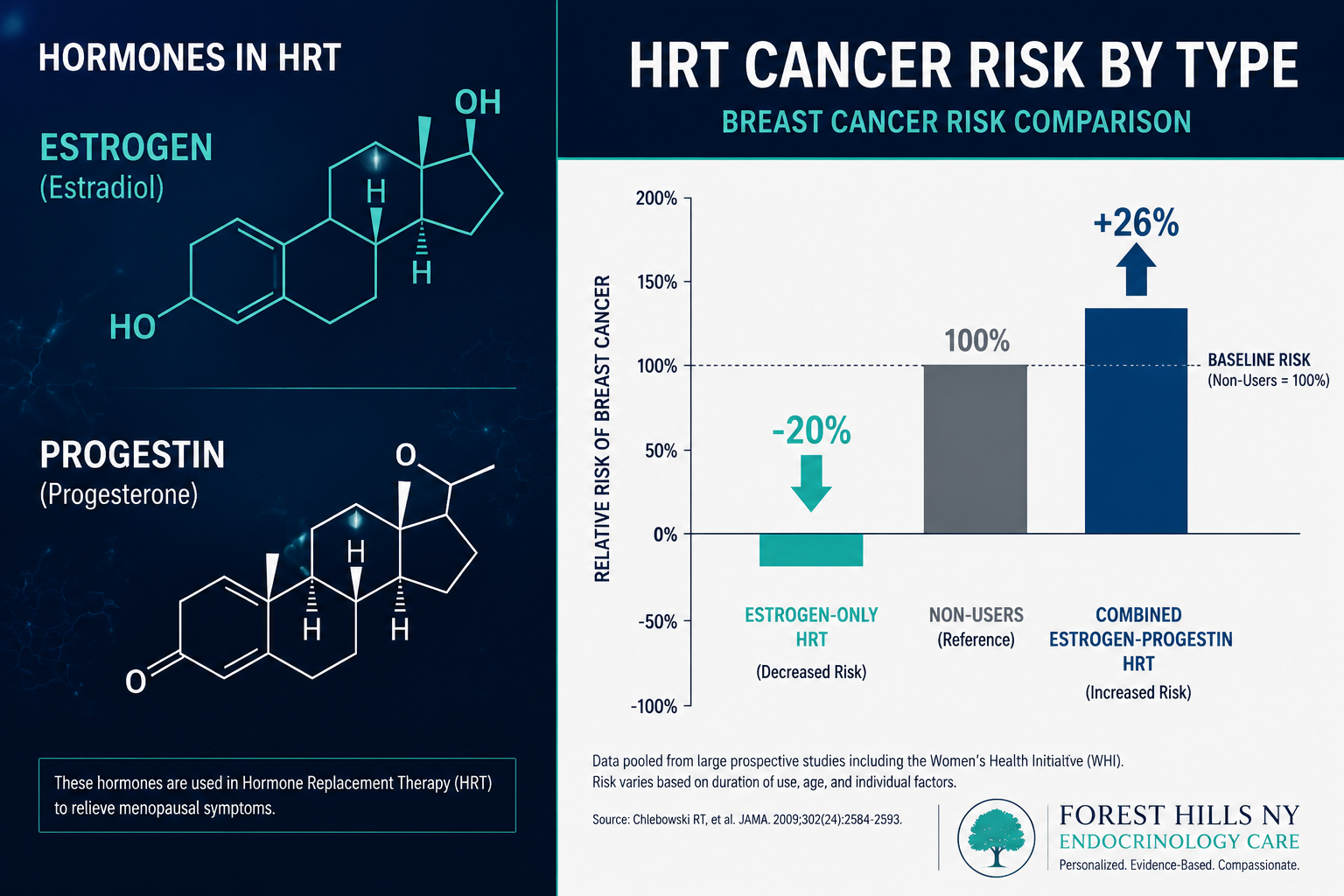
Breast cancer is the concern most patients raise first. A major NIH study published in June 2025 found that women under 55 using estrogen-only hormone therapy actually had a reduced risk of developing it compared to non-users. Nevertheless, women in the same age group using combined estrogen-progestin therapy showed an increased risk.
The National Cancer Institute confirms this pattern: combined EP-HT raises the risk, particularly when started around the time of menopause. This risk appears consistent across different hormone types and durations of use.
One additional factor worth noting is breast density. Combined hormone therapy can increase breast density, which may make mammograms harder to interpret and could independently elevate the risk. This is an important consideration when scheduling routine screenings.
Endometrial Cancer: A Risk Tied to Estrogen Alone
Estrogen-only therapy, when used in women who still have their uterus, can stimulate the uterine lining and lead to endometrial hyperplasia — a thickening of the uterine lining that raises endometrial cancer risk. This is precisely why estrogen-only HRT is generally reserved for women who have had a hysterectomy.
When progestin is added to an estrogen regimen, it counteracts this effect and significantly reduces endometrial cancer risk. This is one of the clearest examples of how the composition of a hormone therapy regimen directly shapes its safety profile.
Notably, as of February 2026, estrogen-only HRT products still carry a black box warning from the FDA specifically because of this endometrial cancer risk — even as the FDA removed black box warnings from certain other HRT products based on updated evidence.
Ovarian Cancer: A Small but Real Risk
The American Cancer Society notes a slight increase in ovarian cancer risk associated with estrogen therapy, particularly during active use. The absolute increase is small, but it is a factor that specialists weigh when recommending treatment.
Colorectal Cancer: A Potential Protective Effect
Not all the news is negative. Some research suggests that estrogen therapy may actually lower the risk of colorectal cancer. This is an area where the science is still developing, and it does not outweigh other risks on its own — but it is part of the complete picture that endocrinologists and primary care physicians consider.
What the FDA’s 2026 Decision Means for Patients
In February 2026, the U.S. Food and Drug Administration removed the black box warning from certain HRT products. This was a significant regulatory shift, reflecting a growing body of evidence that for many patients — particularly younger women and those in early menopause — the benefits of hormone therapy can outweigh the risks.
This does not mean hormone therapy is risk-free. It means the science has evolved. The American Cancer Society’s updated position emphasizes that the safety of MHT is highly individual. For women under 60 or within 10 years of menopause onset, risks are generally lower. For women with a history of hormone receptor-positive breast cancer, HRT is typically not recommended.
The takeaway: a regulatory label change is not a green light for everyone. It is a signal that the conversation between patient and provider is more important than ever.
Who Should Be Most Cautious About Hormone Therapy
Certain groups face elevated risks and should approach hormone therapy with extra care and close medical supervision:
- Women with a personal or strong family history of breast cancer
- Women with hormone receptor-positive breast cancer diagnoses
- Women with a history of blood clots, stroke, or heart disease
- Women who are more than 10 years past menopause onset
- Women over 60 initiating HRT for the first time
Both estrogen-only and combined hormone therapies have been linked to an increased risk of heart disease, stroke, and blood clots during active treatment. This is a critical reason why heart health should be evaluated before starting any hormone regimen. You can learn more about how hormonal and metabolic factors connect to cardiovascular health in our overview of how metabolic syndrome increases the risk of heart disease and diabetes.
How Endocrinology and Diabetes Care in Forest Hills, NY Fits Into This Conversation
Hormone therapy decisions do not happen in a vacuum. They require a thorough review of your personal health history, family history, current medications, and risk factors. This is exactly the kind of individualized, evidence-based care that our endocrinology and diabetes specialists provide at New York Preventive Health Center.
Our team also comprehends that hormonal health intersects with many other systems. For example, patients managing diabetes or thyroid conditions may have additional considerations when evaluating hormone therapy. If you are curious about how often a diabetic should see an endocrinologist, that same specialist can also guide you through hormone-related questions.
Hormone therapy can also affect bone density, which is why our specialists often discuss how osteoporosis relates to endocrine disorders as part of a complete hormonal health evaluation.
Making a Personalized Decision: What to Discuss With Your Provider
The American Cancer Society and the National Cancer Institute both emphasize that hormone therapy decisions must be personalized. Here is a practical checklist to bring to your next appointment:
- What type of hormone therapy is being recommended, and why?
- What is my personal risk based on my family and medical history?
- How long would I need to use hormone therapy, and at what dose?
- What are the non-hormonal alternatives for my symptoms?
- How will my provider monitor me for side effects or early warning signs?
- Do I need baseline screenings — mammogram, bone density scan, or cardiovascular evaluation — before starting?
FAQs
Does hormone therapy always increase cancer risk?
No. The relationship between hormone therapy and cancer risk is not one-size-fits-all. Estrogen-only therapy has actually been associated with a reduced breast cancer risk in some younger women, while combined estrogen-progestin therapy carries a higher breast cancer risk. Endometrial cancer risk rises with estrogen-only use in women who have not had a hysterectomy, but adding progestin to the regimen largely counteracts this. The type of hormone, the dose, the duration of use, and your individual health history all shape your actual risk level.
Is hormone therapy safer for younger women than older women?
Generally, yes. Current evidence suggests that women under 60 or within 10 years of menopause onset face lower overall risks from hormone therapy than women who begin HRT later. The FDA’s February 2026 decision to remove black box warnings from certain HRT products was partly informed by this age-related pattern. That said, younger women with specific risk factors — such as a personal history of breast cancer — may still face elevated risks regardless of age.
Can hormone therapy affect my heart health?
Yes. Both estrogen-only and combined hormone therapies have been associated with an increased risk of cardiovascular events, including stroke and heart attack, during active treatment. This is why a cardiovascular evaluation is often recommended before starting hormone therapy, particularly for women with existing risk factors. Our team can coordinate this assessment across specialties — from endocrinology to cardiology — all under one roof at NYP Clinic.
How do I know if hormone therapy is right for me?
The only reliable way to answer that question is through a personalized consultation with a qualified provider. A thorough evaluation of your symptoms, health history, family history, and current medications is essential. There is no universal answer. If you are in the Forest Hills, Queens, or broader NYC area, you can schedule an appointment with our team by visiting our contact page or calling us at (718) 997-7100. Walk-ins for primary care are also welcome seven days a week.
References
- National Cancer Institute. (2022). Menopausal hormone therapy and cancer. U.S. Department of Health and Human Services. https://www.cancer.gov/about-cancer/causes-prevention/risk/hormones/mht-fact-sheet
- American Cancer Society. (2024). Menopausal hormone replacement therapy and cancer risk. https://www.cancer.org/cancer/risk-prevention/medical-treatments/menopausal-hormone-replacement-therapy-and-cancer-risk.html
- National Cancer Institute. (2023). Breast cancer risk: Menopausal hormone therapy. https://www.cancer.gov/types/breast/research/menopausal-ht-risk
- American Cancer Society. (2026). What to know about hormone replacement therapy and cancer risk. https://www.cancer.org/cancer/latest-news/what-to-know-about-hormone-replacement-therapy-and-cancer-risk.html